 Issue #21
Building the Future We Desire with Sarah Dubreil
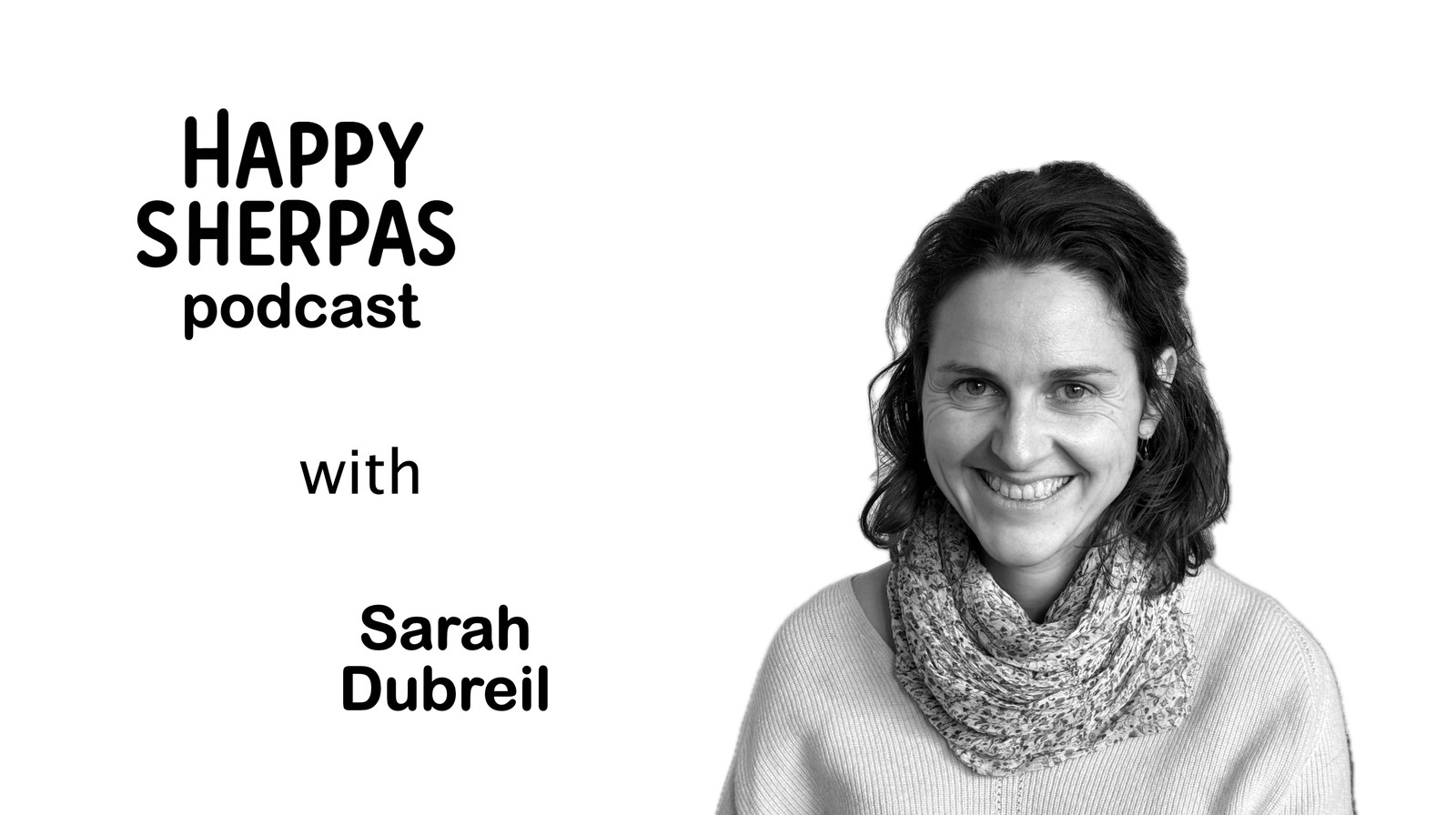
I am thrilled to announce the launch of our new podcast, Happy Sherpas, co-hosted with my friend Virginie Vitiello. We hope to meet entrepreneurs, financiers, explorers and scientists who dare to question the world, step off the beaten track, and show us ways forward.
Would you like to know how to create fruitful collaborations to make the future you desire a reality?
That question opens our very first episode. Virginie welcomes Sarah Dubreil, expert in systemic strategies for adaptation & resilience. Her work connects deep research with real-world application, helping companies and investors rethink how they make decisions in a complex world.
From clean tech to systems thinking
Sarah’s path began in the world of corporate venture capital, investing in clean technologies for SUEZ. She later worked in corporate venture building, co-developing a deeptech in atmospheric carbon measurement, origins.earth, trying to link science and finance. But something didn’t work. In her own words:
I started to see that our methodologies were failing us. [...] We were looking at things in silos: carbon first, nature then, etc. It didn’t help us take the best decisions.
That realisation led her to study systems thinking and regenerative approaches, blending research with practice. Regeneration is about building the capacity for humans and nature to be vital, healthy and thrive. Through regeneration, our ‘socio-ecological systems’ become more resilient to shocks.
Sarah has worked with the Club of Rome, Bpifrance Le Lab and HEC Paris. Her mission is to bring systems approaches into the heart of the real economy to build capacity for adaptation & resilience.
And as part of that work, Sarah develops workshops for business leaders and entrepreneurs based on the Three Horizons model to help us rethink how we build, finance, and grow companies.
Rethinking finance — from observer to agent
In the world of finance, we are trained to behave like observers, detached from the object we analyse. We categorise risk, performance, and investment topics into taxonomies but miss the deeper interactions and feedback loops between nature, people, and economy. Systemic approaches change that perspective.
Instead of asking “Is this green or brown?”, we ask: “In this context, which dynamic am I reinforcing? Am I contributing to a world aligned with planetary boundaries or reinforcing business as usual?”
This subtle shift opens the door to more nuanced and balanced decisions. It balances the quantitative, what we can measure, with the qualitative, that is no less real. Sarah points to emerging practices like alignment indicators (already pioneered by funds such as 2050) that complement financial metrics with systemic and relational ones.
This focus on systemic relations also creates a mindset shift: when we become participants rather than observers, we gain agency. Both individually and collectively, we can shape the future!
In times when the “most probable” future looks dystopian, our energy is better spent not on predicting the worst, but on building the best.
The Three Horizons: a compass for the transition
One of the most practical frameworks Sarah brings to companies is the Three Horizons model, originally developed by researcher Bill Sharpe, co-founder of Future Stewards member of the International Futures Forum (IFF).
Most business planning is linear: short, medium and long term. The Three Horizons approach brings crucial subtlety in that it maps three ways in which the future interacts with the present. Horizon 1 dominates the short term; it represents “business as usual”. It should not be dismissed, on the contrary! One needs to live today in order to live tomorrow…
Horizon 2 is that of emerging innovations: they could relate to the medium term, but the key here is that they are already there, present today. They are bridges of transition, and as such, should be designed intentionally, not just to survive, but to bring Horizon 3, the desirable future we aspire to into the present.
Again, this desirable future already exists, albeit in small, fragile and sometimes marginal initiatives. It is up to us to nurture it intentionally.
Companies shifting from “green or brown” to nuance
Sarah has facilitated this process with over 800 business leaders, notably through the CEC (Convention des Entreprises pour le Climat), a collective journey guiding companies from understanding planetary boundaries to designing regenerative strategies. One example is ACORUS and more specifically its activity Les Menuiseries Rennaises, a pioneering French company in home renovation, featured (in French) in Le Plongeoir.
Before the workshop, their first roadmap was framed: moving away from new construction, reducing technology use, focus on the home renovation sector. But through the Three Horizons exercise, their perspective shifted. For example, “they realised that to bring a regenerative future for housing into the present, they shouldn’t abandon new construction; they should redefine it. Stay in, but as thought leaders, selecting only the projects where they can truly embody that future.”
They also revisited their portfolio of building renovation customers, and realized that part of their customers’ activities were actually ecologically harmful. This led to the more nuanced question of « which future are we helping to bring into reality? »
Even their view on technologies like drones changed. Instead of asking whether drones are “green or brown,” they began asking: “In this context, does it reinforce business as usual or does it make regenerative futures come true faster?” For example, using drones for façade cleaning and rehabilitation can avoid the need for scaffolding trucks, reducing both materials and emissions.
Looking toward Horizon 3, they began envisioning entirely new activities, such as the vegetalisation of not just roofs, but façades and walls. That shift from segmenting and analysing to understanding dynamics and systemic impact is where the real power lies. It means going from « green or brown » to nuance.
From decarbonisation to regeneration & resilience
Together with Laurence Lehmann-Ortega at HEC Paris, Sarah recently co-authored a white paper on The Regenerative Shift: Seven Business Attributes and Seven Archetypes to inspire action. They analysed forty organisations considered as pioneers by regenerative networks, based on public data. The patterns they found reveal a new generation of business archetypes that go beyond decarbonation or circular economy. Among them:
- Regenerative System Conveners are organisations that begin with a new narrative of what has value, and build collective capacity to realise that narrative. For example, the Savory Institute or Commonland have brought together farmers, brands, and territories.
- Regenerative Site Enablers are place-based organisations like COMFAMA in Medellín, Colombia, which develop activities in healthcare, education, leisure or banking to support the local inhabitants. Established as an alliance between unions and private sector, the not-for-profit supports the sound development of the entire region.
In all these models, collaboration is articulated with competition as the engine of resilience. They don’t optimise one variable, they redesign relationships between actors, sectors, and ecosystems.
Stability as a service
The case of COMFAMA is striking. Born during Medellín’s most difficult years, it brought together businesses, unions, and citizens to rebuild social and economic stability. Today it operates across sectors serving the regeneration of an entire region. For Sarah, this type of organisation offers a powerful lesson for Europe.
If we want to maintain our license to operate in a world facing biodiversity loss and climate risk, we’ll need stability. And these companies are literally offering stability as a service.
And in doing so, they prove the shift from extracting value from the system to maintaining the conditions for life to thrive is possible!
Where next?
Our launch episode of Happy Sherpas reminds me why I started The Makers of Change newsletter in the first place.
We live in a time of transitions. And yet, amid the complexity, there are maps, tools, and guides showing us how to move forward. Sarah Dubreil is one of them! She helps us remember that the future is not something to predict, it is something to design together.
Listen to Happy Sherpas on Apple Podcast, Spotify, or Youtube.
As usual, this letter, originally published on LinkedIn, is meant to open a discussion: join it here.
Lenny Kessler