 Issue #25
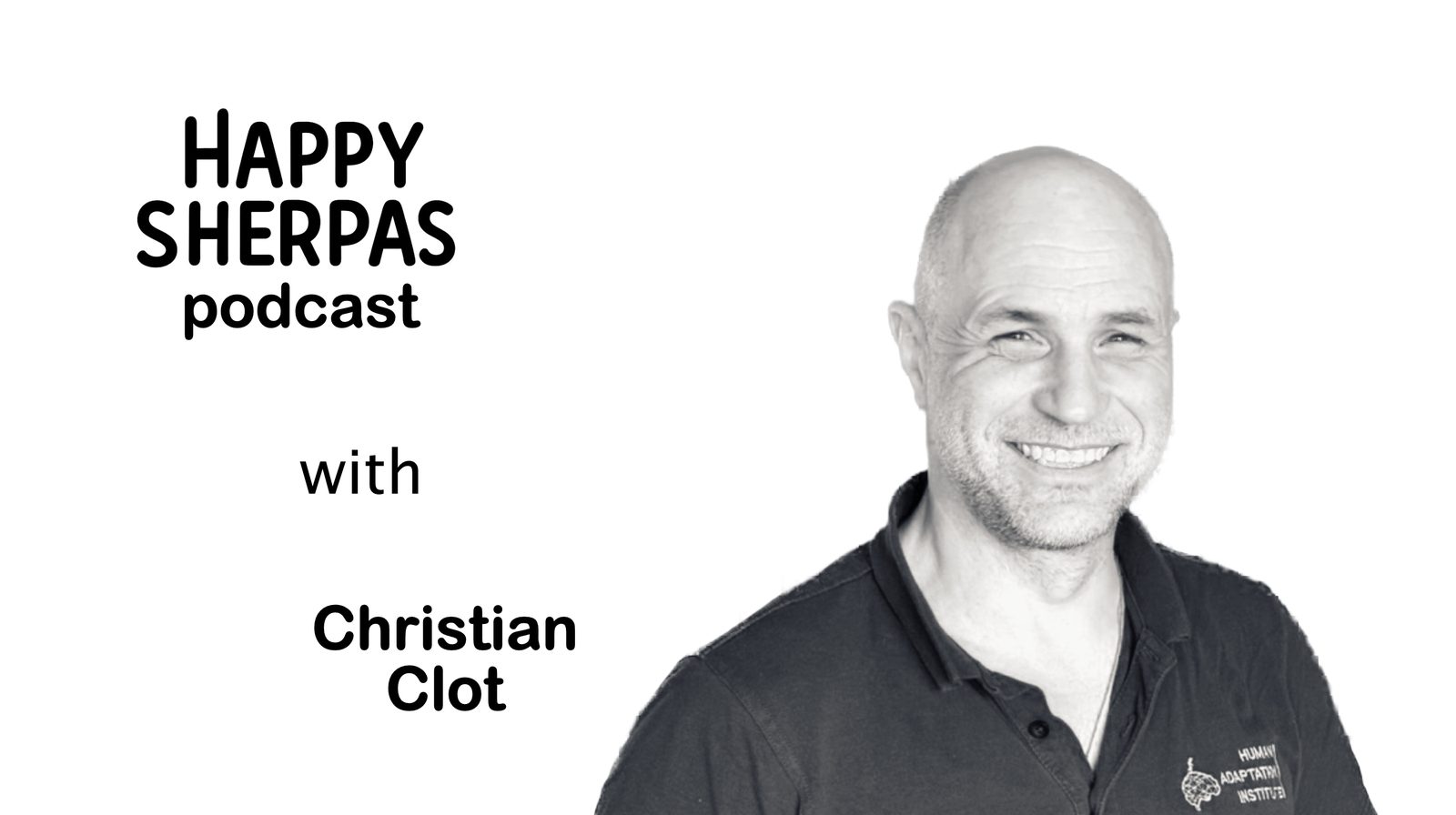
What Actually Moves Us, with Christian Clot
I had the pleasure of interviewing Christian Clot in the latest episode of Happy Sherpas, the podcast I co-host with Virginie Vitiello. Christian is an explorer, author, and founder of the Human Adaptation Institute. He has spent over twenty years in the world’s most extreme environments, deserts, rainforests, polar regions, and has since turned that experience into a science: understanding how humans adapt when their reference points collapse. In the context of the transitions we are all navigating, that question feels more pressing than ever. And his most surprising answer is about joy.
The extreme is closer than we think
The first thing Christian told me upended the premise of his own career: an extreme environment is not a place, but a relationship between a place and a person. For a hunter in Greenland, minus forty degrees is an office. For a Parisian dropped into the same landscape, it is death. The extreme is relative to who you are and what you are prepared for. Which raises an uncomfortable question: what does it say about us, right now? Navigating climate anxiety, geopolitical mess, information technology that questions the very notion of “truth”, all simultaneously, with no training and no map?
The most extreme environment most humans have ever had to adapt to may well be the one we are already living in. And that is oddly reassuring: adaptation is urgently relevant, and it is about us.
The hidden cost of change
We tend to think of resistance to change as a character flaw: laziness, denial, short-termism. But there is a more generous explanation: changing requires the brain to build new synapses and neural pathways to process the world in new ways. That is a metabolic expense the brain is happy to avoid unless the benefit is made very clear.
The question the brain is always asking, beneath the surface of our conscious reasoning, is simple: is what I stand to gain worth what I am being asked to spend? If the answer is not compelling enough, the effort does not happen. Not because people are irrational. Because our brains are economical.
This reframes one of the great frustrations of the sustainability world. We have spent decades producing more data, more reports, more alarming projections, and wondering why behaviour barely shifts. The answer is unambiguous: information alone is never enough. It is processed, filed, and forgotten. To move people, you need motivations the brain can actually act on.
Antonio Damasio showed us why, long before the climate debate reached its current pitch. In Descartes’ Error, he demonstrated through patients with prefrontal damage that losing access to emotional responses does not make people more rational. It makes them incapable of deciding at all. Emotions are not the noise in the system, they are the signal. They tag options with meaning, helping the brain determine what is worth the effort and what is not.
Which means that if we want people to change, the question is not how do we give them more information. It is how do we help them feel something worth acting on.
Emotion is the ignition key
There are essentially two ways change happens. The first is crisis: when the burning platform is undeniable, fear makes the cost-benefit calculation resolve itself. Crisis is a powerful ignition, but a costly one as it destroys things on the way, and the energy spent surviving leaves less for rebuilding.
The second way is rarer but more interesting: deciding to change before the crisis hits. This requires a genuine emotion compelling enough to justify the effort in the absence of urgency, and that is where leaders often struggle. Without a burning platform, we need to find the right positive emotion. Joy becomes the motivation and the fuel for change.
In a world where so many crises are slow-moving and structural, learning to move toward a joyful experience rather than away from anxiety may be the most important adaptation skill of all.
The 40-day wave and the role of pleasure
But deciding to change is only the beginning. Once change begins, the brain follows a reliable rhythm. A first intense phase: high energy, curiosity, a willingness to try things. But that work is expensive, and at some point the brain simply needs to stop. What follows is apathy. Not depression, not failure. Just the brain consolidating what it has learned before it can move forward again.
The danger is misreading apathy as a sign that change is not working. But apathy is not the end of the cycle. It is the middle. And only one thing reliably pulls people through it.
Pleasure. Wonderness. The sudden spark of finding something genuinely interesting, delightful, worth getting up for.
Some years ago, I found myself completely stuck professionally, whatever effort I made. Out of despair, I stopped trying, accepted that things might not work out, and focused instead on bringing happiness back into my daily life. I started dancing tango, every day. And quietly, everything else fell into place. Without knowing it, I was moving through apathy by following pleasure, and letting the next phase flow naturally.
Meaningful change rarely happens in one wave. Adaptation is a succession of these cycles: effort, consolidation, pleasure, and then the energy to begin again. The capacity to find joy along the way is not incidental. It is structural.
Leading adaptation: the art of doing less, better
All of this has profound implications for leadership.
The dominant leader who decides, commands, and charges ahead is neurologically unfit for the kind of adaptation we now need: he will exhaust people before change happens.
People follow what you do, far more than what you say: adaptation requires leading through exemplarity. It means showing up differently yourself, making room for brain diversity, and sometimes letting someone else take the lead. Yes, that is way harder than issuing directives.
Adaptation is fundamentally a collective achievement. No one adapts alone.
And collective achievement starts with humility: the honest recognition that we cannot see everything, know everything, or carry everything alone. The transitions we face, ecological, social, economic, require the kind of collaboration that our competitive mental models make genuinely difficult. Building that collective capacity is a biological necessity, as much as an organisational principle.
Which brings one more thing that leaders resist most: slowing down. We are currently processing more information in a day than our ancestors did in years. The brain needs rest to sustain that load. Slowing down is how you stay in the game long enough to matter.
Conclusion
Coming out of this conversation, I was reminded of something my first mentor told me early in my career: “The hardest thing in work is to do nothing.” Christian Clot gives that observation a neurological foundation: doing nothing, at the right moment, is how the brain prepares for action.
We tend to look at adaptation as better models, smarter policies, greener technologies... But the binding constraint is human. It is our capacity to feel something worth moving toward, to tolerate the discomfort of apathy without abandoning the journey, and to build the collective conditions in which change becomes possible.
And if joy is the condition and the fuel of change, perhaps the very urgency of adaptation is our best invitation to build a brighter future.
And now, what has actually moved you to change: fear of what might happen, or attraction toward what could be?
Listen to this episode of Happy Sherpas on Apple Podcasts, Spotify or YouTube.
As usual, this letter, originally published on LinkedIn, is meant to open a discussion: join it here.
Lenny Kessler